Showing posts with label Social criticism. Show all posts

Monday, October 22, 2018

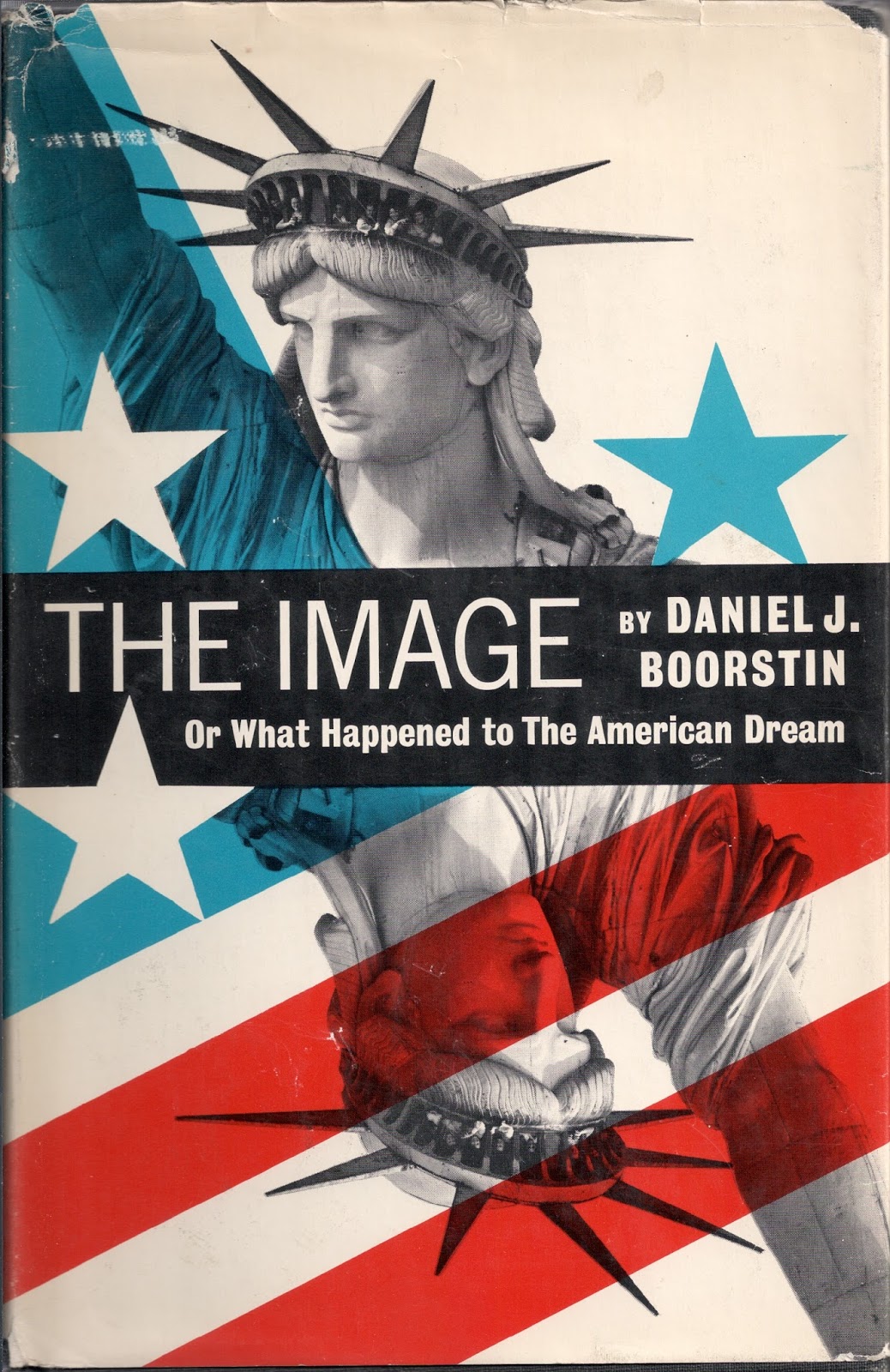
The Image or What Happened to the American Dream - Daniel J Boorstin (Atheneum, 1962)

A critical look at American society and its growing substitution of manufactured experiences and events for actual experience and events.  This piece of social criticism is even more remarkable for how early these trends in American culture were discerned by the author.   [917.3]

This is a deeply perceptive analysis about the direction of American culture in the middle of the 20th century.  Although the book was first written in 1962, the analysis could read as a modern critique of American culture and our intellectual and moral outlook.  The key concept for this book is the "pseudo-event."  A pseudo-event is a planned happening or news event, like a press conference.  It an event arranged or brought about merely for the sake of the publicity it generates, especially one designed to appear spontaneous or unplanned. It isn't truly spontaneous, but is particularly designed for press coverage.  Boorstin defines a pseudo-event as an ambiguous truth that appeals to people's desire to be informed.  The problem, in the author's judgement, is that our "news" is increasingly made up of pseudo-events.

One of his key examples is the 1960 Presidential debate.  Boorstin questions whether the quiz show format is in any realistic way revealing about what sort of President either man might be.  (This trend has only worsened as the response time allotted to a speaker is reduced to a few minutes.)  Note what is remembered about that first in the Presidential debates series: that Nixon perspired and looked unshaven because of the make-up he was wearing and that perceptions of who carried the debate depended on whether one saw it on television or heard it on the radio.  Although such an event feels like something important is occurring, subsequent debates have come down to exercises in which each candidate is trying to land a well-rehearsed catchphrase rather than outline in any detail specifics of his programs.    

Flowing from the concept of a pseudo-event is the author's definition of a celebrity as a person who is famous for being well known.  That the concept is an empty tautology is of no matter to society today.  The critical difference from Boorstin's view is that one may not be able to consciously become a nationally honored hero, but one can campaign to become a celebrity with a good chance of success.  All that is required is the effort and means of getting one's name known.  (Our mass media and our need for something to talk about in a full-day news business have made the task of becoming a celebrity easier.)  Think of how often Warhol's "15 minutes of fame" aphorism is invoked today.
   
The second key concept is "image."  Boorstin argues that our culture has replaced ideals with images.  The difference between the two is significant.  An ideal, say, honesty, is a goal or quality.  It may not be attainable fully, but it is something to aspire to.  An image is a created picture of oneself or of a corporation or any other organization.  An image can be changed.  An image is expected to be achievable.    

This book is more than 50 years old.  It may even seem a bit quaint in what it considers shallow or unworthy.  At times the audible sigh of a world-weary observer comes through the text.  Boorstin did become a social conservative.  (He was, however, of the type of old-line conservative that has been replaced by a "conservatism" of advocacy.)  These aspects may make the book a slower read at points.  It may seem to be describing a world we acknowledge is long gone rather than as a world that is still slipping away.  If anything, there is no way to go back to the American society of 1960..    

Still, the book is a striking read and is recommended.


Tuesday, September 26, 2017

The Death of Expertise - Tom Nichols (Oxford University Press, 2016)

An extended critique of the shifts in American public discourse that have elevated the opinions of everyone regardless of their expertise and lowered the relative weight given to expert judgement.  The author reviews a number of aspects of modern American life where expertise has been eclipsed by an equality of opinion regardless of the basis for any single view.  Tom Nichols is a conservative intellectual.   [303.4833]

This is a book that, by its title, invites approval from professionals in public arenas and by educated individuals.  It is becoming clear to subject matter experts that public policy discussions often degenerate into exchanges of opinions by the masses with little weight given to the opinions of genuine experts.  This may be the book that we have awaited; it is at times, however, disappointing in its delivery.  The result is less of an analysis than an extended statement of informed opinion.  Comforting as such texts may be in reassuring policy professionals that the problem is real, they lack utility when they fail to highlight the underlying causes that must be addressed if the problem is to be solved.  The book grew out of an article of the same name that Mr. Nichols had published in The Federalist.  A journal article may be expected to limit its analysis to a clear statement of the problem; a book, however, deserves a deeper analysis.

The opening states the basic problem: that there is a distinction to be made between citizens and subject experts and citizens are becoming comfortable with disposing of the experts.  If experts are not needed, then each person may seek information on their own.  Unfortunately, we prefer hearing information if it matches our current biases.  Such confirmation bias provides an easy basis for sorting through the myriad hits that any internet search can yield.  And, those hits will include rumors and old-wives' tales as well as "junk" research.  When our discussions take a political aspect, such as questions of foreign affairs or economics, citizen's refusal to accept an authority whose well-founded views conflict with the unschooled views of the individual, the latter will hold final sway.  If no appeal to authority can be made, much of our conversation becomes a tedious re-hash of positions with no defensible justification.  This is tedious.  At their worst, our exchanges become nasty ad hominem rages at each other.

The author enters into the well-worn topic of the inadequacy of public education, particularly at the university.  The allegation, sadly, is not new and it is a waste of time to simply re-plow the same furrows.  In Richard Hofstadter's  book Anti-Intellectualism in American Life (1963), the last chapter cites studies and reports from the 1890s and the 1920s and later that report American students incapable of finding the Pacific Ocean on a map or similar instances of ignorance.  It would be more useful to inquire why universities and colleges (if there are any institutions that cling to that less grand title) have changed their focus.  Why has the change taken place?  An analysis, for example, that argued how the continuing cuts in aid to state schools has made them far more dependent upon tuition and that requires attracting and keeping students.  Small private colleges might need to follow suit since they are competing for the same market.  (It may also be that the absence of a draft has removed the incentive for students to please their schools.)  The issue of grade inflation, if it is a real phenomenon, at elite schools poses a different problem.  With the stagnation of most incomes and the widening distribution of wealth or incomes, a degree from an elite school may have significant market value.  Why then, does Harvard or Yale need to create satisfied customers?  Why has the gentleman's C been replaced by the gentleman's A-?  Here the text is silent; it only notes the problem.

Two topics that the author enters into are noteworthy.  He points out that the metrics often used to assess expert opinion are the wrong ones.  Comparison of expert predictions against purely mechanical systems (throwing darts) or mass voting are the wrong measure.  Experts may be wrong, but the reasoning underlying their opinions is more valuable than random methods.  In short, being wrong may not be the real test.  The author proposes, instead, to keep track records of expert opinions and to include assessments of their work evaluated by other experts.

The book needed a better editor than the author got from his publisher.  A serious reader would have noted shifts in argument with a half-dozen pages or an overall lack of an argument.  The author at one point argues the phrase familiar to on-line comments that the United States is a republic, not a democracy.  Three pages later, the author uses democracy as it is generally used to describe our polity.  The text sometimes hints that a good outline might have tightened the presentation.

For summarizing the problem at its first level, the book may be recommended, if not warmly. 
For providing a sharper analysis of how we got there, the book fails.