Showing posts with label bubbles. Show all posts

Wednesday, August 31, 2016

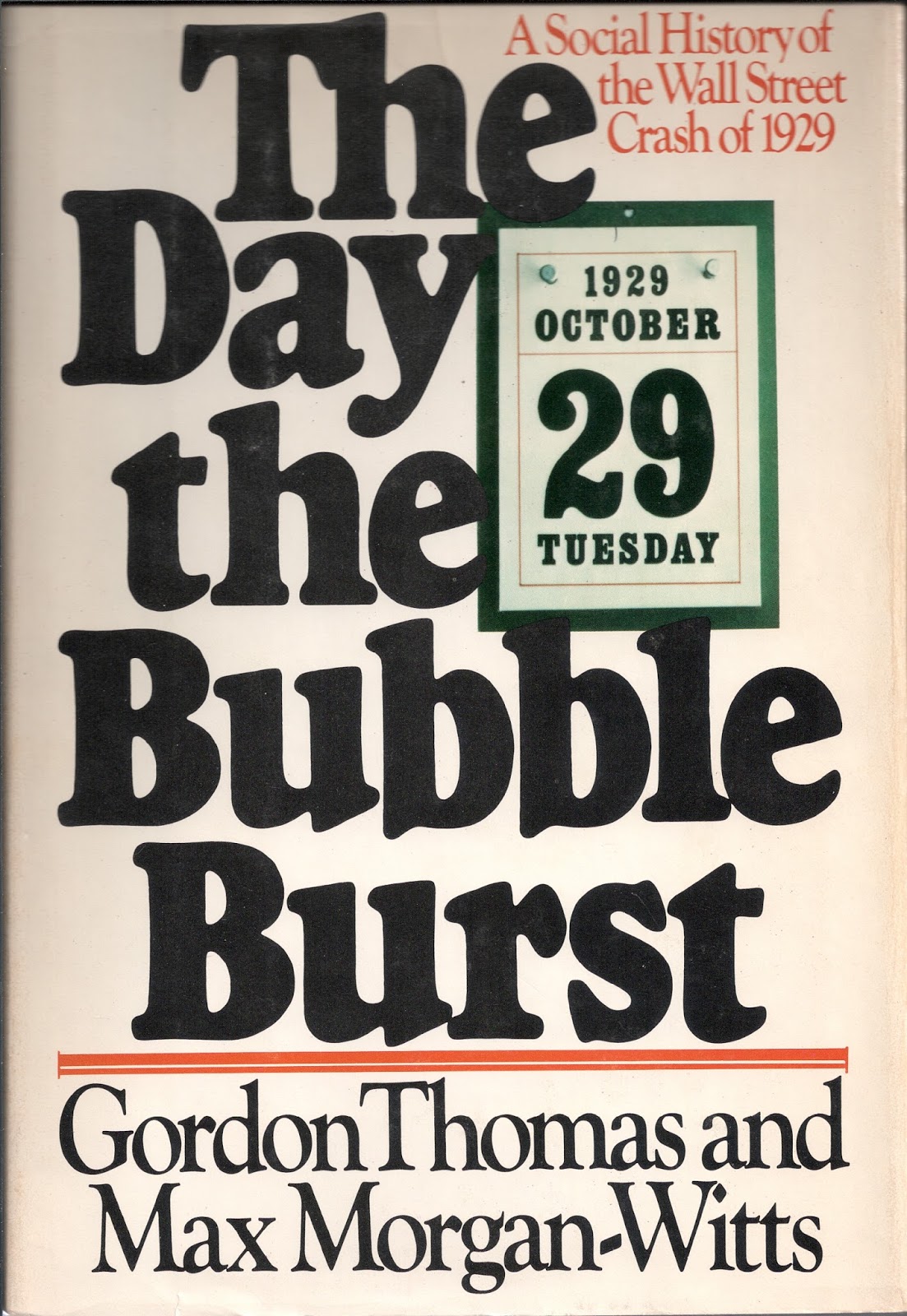
The Day the Bubble Burst - Gordon Thomas and Max Morgan-Witts (Doubleday & Co, 1979)

This is a social history of the Great Crash of 1929.  It weaves together the individual histories of dozens of persons whose lives or fortunes were deeply affected by the Great Bull Market and its subsequent collapse.   [338.54]

Neither of the authors of this book is an economist or a business writer by profession.  The style of the book is quite different from most financial histories in that it spends more of the text on recording the thoughts and feelings of the characters.  In fact, it is more like the style one expects to find in a novel.  The attribution of thoughts or feelings to the main characters would make a reader suspicious of the validity of the accounts except for two things: the book was written forty years ago when many of the principals or their families were still alive and available for interview and the authors cite numerous journals, diaries, and interviews among their sources.

The book covers the last months of the Great Bull Market from New Year's Eve 1928 to October 1929.  It is not restricted to the usual players in the Street, but takes individuals at several levels of society and at venues outside New York.  These individual stories reinforce the narrative by adding a poignancy to human plans overwhelmed by the event.  There are several projects or goals set by the participants for the last week in October that the reader knows will never come to fruition.  The stories include the standard players such as Michael Meehan, the pool operator; Thomas Lamont and George Whitney, partners at Morgan; Richard Whitney, George's brother, embezzling from his customers for one bad investment after another while president of the NYSE; Jesse Livermore,  who often blamed for the Crash because he often sold short; Charles Mitchell, famous for placing bids on behalf of the bankers' group to try to stabilize the market, but who also was selling short the stock of his own bank; and Professor Irving Fisher, the economist whose serious work on the money illusion has been swept aside by his Panglossian pronouncements.  

The authors go further and include other characters to give a broader sense of the easy riches mania that seemed to carry away the country.  There are also Henry Ford, eccentric and living in an America that is fading into the past; Joseph Kennedy, snubbed in his visit to the House of Morgan, but having a better sense of the market than his "betters"; John J. Raskob, focused on his plans to build the Empire State Building; A. P. Giannini, laboring against the fear that his Transamerica Corporation might become a tool for speculators and also seen as an upstart by the J. P. Morgan firm; the "league of gentlemen," fifteen clerks and officers of Union Industrial Bank of Flint, Michigan, each of whom was embezzling from the bank to invest in the stock market; and the Vargo family, immigrants in Flint and bootleggers who trusted their savings to the Union Industrial Bank.

By following each of these stories, the reader is reminded that the Crash did not happen on just one day; the market's collapse took place over several days.  At the end of each of those days, there was a hope that the rally might undo the damage.  The reader will likely feel a pang of sympathy for the characters because we know the end of the story.  That is something too often missing from economic history: the sense that no one at the time knew how the story would end.  We can empathize with their frail hopes.

This book is recommended for a sense of the mania for easy money that swept through society during this period.

Thursday, June 2, 2016

The Big Short: Inside the Doomsday Machine - Michael Lewis (W W Norton, 2010)

An engaging story of the challenges facing a few individuals who bet against common wisdom  to profit on the 2007-8 housing market collapse. [330.973]

One path to good storytelling when dealing with complex issues is to report from the point of view and actions of someone involved in the events.  This doesn't necessarily make the event itself any clearer; instead it trusts that the reader may appreciate the challenges the protagonists face and it conveys a feeling about the events.  This look at the financial implications of the housing market collapse in 2008 attempts to explain events by following three hedge funds and a banker as they try to make sense of what appears to them to be an asset bubble and to find a way to take the opposite side of the trade.  It takes great self-confidence, or foolhardiness, to take a short position when the world is convinced prices can only move upward.

The uninitiated reader is unlikely to come away from this book with a clear understanding of derivatives trading, credit default swaps, or collateralized debt obligations, but this book is not intended as a CFA textbook on derivatives.  In fact, this book should be read alongside Gillian Tett's book Fool's Gold to really understand how such a market developed.  The pair of books gives a richer context to the trading.

Michael Lewis is, nonetheless, a talented writer.  The traders and bankers he describes are complex personalities.  They are not heroic; they see an opportunity to make money and have to develop a way to exploit the situation.  They have to keep their financial backers and investors behind them while the action they propose violates accepted wisdom.  They have to abandon any faith in the leading names in the financial community.  Once events begin to run their way, they have to decide how long to hold the trade before it becomes worthless.  Here is Lewis' talent: giving the reader a sense of the inner workings of these people.

We are still living with the results of the crisis.  It still plays a role in the political campaigns this year because it has affected how we interpret the work of Wall Street, the government, and the markets in a broad sense.  This book is still timely even as it describes events that are a decade ago.

(NB.  The movie of the same name is equally enjoyable and should be watched in conjunction with Margin Call to see both sides of the story, but it has fictionalized some parts of the story and simplified other parts.)

This book is recommended although with the suggestion that the experience improves if one takes time to learn more about the derivatives and the securities discussed.

Thursday, April 28, 2016

Tulipmania - Anne Goldgar (University of Chicago Press, 2008)


A serious review of one of the iconic financial bubbles in European history.  The author suggests that legend has largely shaped our views on its origin, extent, and impact on Dutch society.  [330.949203]

This book re-examines the Tulip bubble of 1636-7.  Its premise is that everything we all have read in Extraordinary Popular Delusions, in Burton Malkiel, and elsewhere is based on flawed documents.  All of these derive from a single 18th century source (or from MacKay who used this same source) that drew its information from 17th century pamphlets.  The pamphlets were written with didactic or moralizing intent rather than as actual history.  They exaggerated the spread of the speculation in society and its economic impacts of the Dutch economy. 

The book asserts that the Tulipmania we all know never really happened.  There was a rise in prices, but the trade was confined to a fairly small community of traders with a high concentration within the Mennonite religious sect.  The records indicate few bankruptcies resulting from the collapse in prices.   The plague in Holland in 1636 led to inherited wealth and a new attitude toward earthly pleasure also encouraged the bubble. 

One interesting financial aspect to the actual trade is that for seven months of the year, the bulbs stay in the ground.  The trade depended heavily on forward markets and prices.  That is why the collapse led to some problems of honor among the merchants - with a forward contract the temptation to renege is high when prices fall.  There is also the problem we saw in the repo fails situation in 2008 when contracts are daisy-chained; one failure to deliver disrupts an entire series of trades. 


The book can be a bit of a long read.  Goldgar, the author, is fairly detailed on the development of tulips as objects of beauty, for the newly prosperous merchant class of Holland in the Golden Age.  She goes then into the society that engaged in the tulip trade and how small this group was and how disputes were settled.  Finally the book begins to address the tulip market.  The main point is that the pamphlets that misled later readers reflected uncertainty about the new social mobility, the rise of new classes and the impact on traditional notions such as value and honor made all the more severe by the stress of dishonored contracts. 


In the end, however, such revisionist history is satisfying.  The book's subtitle "Money, Honor, and Knowledge in the Dutch Golden Age" explains the breadth of the argument.  It makes more sense of what is usually cited as simply the madness of crowds.

This book is recommended and highly recommended for readers with an interest in art history and Dutch culture.

Thursday, April 7, 2016

A Short History of Financial Euphoria - John Kenneth Galbraith (Penguin Books, 1994)

A look at three hundred and fifty years of speculative bubbles and the common characteristics of the major events.  The same dynamic, the same belief in something new appears in surprisingly short cycles.  "The world of finance hails the invention of the wheel over and over again, often in a slightly more unstable version."  [332.645]

This very slim volume (113 pages) is written with Galbraith's wit and sharp insight.  During speculative periods one may note the belief that either some new asset has arisen which can be expected to rise in price for an extended time or that others may be fooled, but it will be possible for the shrewd individual to know when to get off the ride, and that doubters are to be condemned.  Common to the rise of bubbles are the shortness of financial memory (previous episodes are forgotten) and the specious association of money with financial genius.  Unfortunately, the financial innovation that arises is usually some variation on leverage which works wonderfully in rising markets and extracts a terrible price in falling ones.  Those enjoying the benefits of leverage are hailed as financial geniuses.  When the crash comes, something other than greed or stupidity is blamed.  In the past, crashes have been blamed on program trading systems, or government reports, or small changes in GDP.  Certainly, the market cannot be at fault because that would violate the central tenet of the faith in the perfect market.  The last crisis covered is the 1987 savings and loan fiasco and the market collapse.  What gives credit to Galbraith's analysis of the common factors in crashes is that the reader can see the same factors and reactions in the dot com bust and in the great collapse of 2008.   

The author then follows major speculative bubbles from the Tulip mania (a review of another, better work on this will appear here eventually) and the South Sea Bubble through the 1929 crash and the 1987 Meltdown.  Because he is trying to cover 350 years in so few pages, the descriptions are useful only as a reminder of other works one might read of these events.  That becomes the weakest part of the book.  The book's real value lies in the common threads it finds.

This book is recommended with the caution noted above.


Friday, March 11, 2016

The Great Bull Market - Robert Sobel (W W Norton & Co., 1968)

A history of the economic and financial conditions that drove the bull market of the 1920s.  [332.642097471]

Most histories of the 1920s stock market (and there are some excellent ones) focus on the Crash as the central theme of the book.  This book is refreshing in that it treats the collapse as significant, but not the whole story.

Sobel begins with a description of the immature financial markets of the end of WWI.  Wall Street was not yet a major topic of daily discussion in America.  New York had not yet eclipsed London as the world's financial capital. 

The author looks at a number of individual events that would contribute to the economic growth of the 1920s that fed a real growth in equities and those which added to the speculative frenzy that gave the market its froth.  There were new technologies that were spurred by a new approach to consumer credit that generated, through a macroeconomic multiplier effect, more disposable income in society.  The Washington Naval Conference of 1922 led to some disarmament and a relaxing of tensions following the First World War to further spur consumer confidence.  There was also Winston Churchill's foolish decision to return the United Kingdom to the gold standard at the pre-1914 level.  To help the British prop up the pound, the New York Federal Reserve lowered money market rates that fueled the call money market and buying stocks on margin.  Finally, there was the growth of trusts and informal collusion among major firms, such as steel companies, that increased profits that justified higher stock prices.

What Sobel has done is to re-examine the economic conditions of the 1920s.  He investigates how changes in American society contributed to the forces that created the great bull market.  Although we have a tendency to see the Crash of 1929, in retrospect, as the inevitable result of those forces, Sobel argues hard against that viewpoint.  The reader will find himself reviewing tables of stock prices and other data rather than hearing the famous old stories.  The new insights are worth having.

This book is recommended.

Wednesday, March 9, 2016

Devil Take the Hindmost: a history of financial speculation - Edward Chancellor (Penguin Putnam, 2000)

As long as markets have been part of Western society, there have been periods of frantic speculation - of bubbles - that have destroyed some of their participants when the world suddenly changed.  This is a history of some of these events.  [332.645]

A colleague who worked as a financial advisor once told me that he gave a copy of this book to every new client.  In looking over this book again, I must admit that he was acting in his clients' interest if his intention was to warn them about the likely tears that would follow any enthusiasm for the next sure thing. 

The text covers the major speculative frenzies from the South Sea Bubble to the Asian crisis of 1997.  In each, one meets knaves and swindlers and deluded crowds who are driven to get rich easily with their, usually, small capital.  The story always ends up the same, but often in new ways each time.  The catalogue of disasters is long; it includes the South Sea Bubble, the railway mania of the 1840s, the market manipulation of the Gilded Age, the Crash of 1929, the shady trading of the 1980s, and the Japanese collapse of the 1990s.

The author does more than recite the sequence of events.  He adds a commentary that brings many of these stories to bear on current attitudes.  For example, Chancellor draws a set of parallels between the attitudes and approach of the investor in the 1920s bull market and those of the investor of the 1990s.  Such texts remind us of why history is so important.

This book is highly recommended.