Showing posts with label speculation. Show all posts

Wednesday, September 6, 2017

The Panic of 1907 - Robert F Bruner and Sean D Carr (John Wiley & Sons, 2007)

This is a case study of a bank panic and the financial community's response to stem its consequences.  Because the incident predates the formation of the Federal Reserve System (and provided a motivation for doing so), preventing further contagion throughout the banking sector fell to the New York banks under the leadership of J. P. Morgan.  A review of the causes draws quick comparison the events of 2008.  [333.9730911]

With startlingly clear insight, or good luck, the authors published this book in 2007 on the centennial of the bank panic of 1907.  That panic threatened the banking system through insolvency exacerbated by runs on the banks.  brought the collapse of the Knickerbocker Bank and threatened to spread contagion throughout the banking system.  The risk to the banking system in this instance was similar to so many other bank crises: the interlacing lines of credit that could pull down several institutions even a second- or third-hand.  The bank run stresses the reserves of other banks as depositors act on precaution to withdraw their funds from even safe banks.  The result of drawing down reserves tightens short-term credit to paralyzing levels.  The collapse of the credit market carries knock-on effects for other institutions including those outside of the banking system.  When these events fall during a period in which the financial sector has already been battered - say, in insurance losses - or there is a slowdown in commerce, the impact can be devastating on the economy.  Saving the situation calls for the means to inject reserves without restraint into the banking system.

In hindsight, it is easy to see how the situation in 1907 paralleled that of 2008.  One might forget the effect of the San Francisco earthquake and fire had on insurance companies and the financial markets although losses from Hurricane Katrina may have played a similar role.  The first financial institutions to weaken lost their reserves in dodgy or highly speculative financial plays; in 1907, it was copper.  The network of financial relationships relayed that shock through the system  The challenge lay in the absence of a central bank or other means of injecting reserves into the system to steady it during bank runs.  Only by the grace of J.P. Morgan's intervention and action in commanding solvent banks to lend heavily to other banks that may be shaken but remained fundamentally sound was the crisis stemmed.  Banks had to follow Morgan's direction if they hoped to ever have relations with the Morgan community in the future.  It was the lesson of this panic that led to the establishment of a semi-private network of reserves available to member banks as a means of stopping contagion.  That network was the Federal Reserve system created by the Act of December 23, 1913.

This book is recommended.  The reader should be warned that the authors are not always as clear in laying out the full situation in 1907 and some of the narrative seems to wander until it is brought back sharply into focus.

Friday, October 28, 2016

The Money Game - 'Adam Smith' (Random House, 1967)

A witty exploration of the psychology of Wall Street - why people play the game and how they do it.  This is not another investment guide; it is brilliant sociology.  [332.678]

How is the investment world of 50 years ago different from today?  Maybe there are fewer brokers that the client calls to see how the market is doing.  There are fewer old-line investment houses functioning as banks for wealthy clients.  Along with that, the old fixed commission system is gone that supported so many of those old houses.  There are more investment products available, even as some industries (e.g., aluminum) offer fewer companies to choose among.  Certainly, there is more information about prices and markets within easy reach.  The author would argue, however, that one thing has not changed: the underlying motivation for many participants in the market.  Taking a comment from Lord Keynes, the author argues that it is the game aspect itself of speculative investment that draws many players.  Yes, money is useful for keeping score, but it may not be the end in itself that is being pursued.   

George J. W. Goodman, writing under the pseudonym Adam Smith, draws a series of portraits of the players and in sketching them highlights their inner workings.  The cast includes Odd-Lot Robert who is the small investor who always thinks the "Big Boys" are planning something; Charley and Poor Grenville, and the Kids, all fund managers; the professional gang hanging around Oscar's who could have walked off the set for Mad Men; several investors who are patients of Harold the Psychiatrist who reveal all the ways in which money and the market fit into their lives and it usually isn't in the ways economists assume money fits into a rational individual.  They are Chartists, analysts, small investors (in odd lots), irredeemable speculators, and guys who just like to trade information.   One key that the author finds is how many players just want to be in on the game; they want to be where there is action.

For a light diversion, there is a chapter on The Cocoa Game to warn against the very different world of commodity trading.  For a darker chapter, the Gnome of Zurich appears to present speculations about the dollar and trade and gold that a dozen years later would all prove true. 

The writing is bright and clever.  The humor is subtle yet rich like the clubs that Goodman describes.  This is a book to read when one wants to be reminded that the world continues in a great cycle of rising markets, hot prospects, disillusionment, and gloom...and that it always has been that way.

This book is highly recommended.   

Saturday, October 15, 2016

The Gold Ring: Jim Fisk, Jay Gould, and Black Friday, 1869 - Kenneth D Ackerman (Harper & Row, 1988)

An account of the attempt to corner the gold market in the early Grant Administration.  The book's portraits of dishonor and double cross are staggering.  Taken as historic evidence, the story contains valuable warnings about markets and regulation.  [332.645]

"A fellow can't have a little innocent fun without everybody raising a halloo and going wild"  - Jim Fisk

It is difficult to conceive of how financial markets operated in an era of no regulation.  The picture drawn in this book is one of stunningly corrupt institutions dominated by wholesale fraud; in fact, perhaps either the term "markets" or "operated' is the wrong word to describe these money exchange forums.  The two of note in this book are the New York Stock Exchange and the Gold Exchange. 

The narrative revolves around seven people.  Jay Gould and his sometime business partner Jim Fisk engaged in market manipulation while using the treasury of the Erie Railroad as their personal cash source.  Cornelius Vanderbilt, with his New York Central railroad, was a constant competitor of Gould and Fisk.  William Marcy "Boss" Tweed supported Gould and Fisk with lawyers and pliable judges whose injunctions could be used to limit liability or to award custodianship of disputed assets.  Abel Corbin became a partner with Fisk and Gould because he offered a valuable connection - he was the President's brother-in-law.  President Ulysses Grant had been in office only a few months as he and his Treasury Secretary, George Boutwell, worked to move the country back to hard currency after the issuance of Greenbacks during the Civil War.

The author establishes the characters of several of these persons by describing the "Erie Wars" in which Gould and Fisk struggled with Vanderbilt over control of the Erie railroad and on securing a right-of-way to link with Midwestern railheads.  Although both sides were willing to use gangs of toughs on the rail lines and bribery in Albany to get the rights they sought, a novel scene on the stock exchange is more effective.  Once Vanderbilt decided to simply buy a controlling interest in the Erie, Gould and Fisk set up a printing press and simply kept printing stock shares to sell him.  (No regulations regarding registering shares or provisions against watering stock existed.)  When the Erie Wars became too notorious, Gould and Fisk simply holed up in New Jersey while both sides used the courts to get the outcome they wanted.

The central story, however, involves an attempt to corner the gold market.  Gould and Fisk might be able to lock up all the free gold immediately available in New York, but they could not hold out long if the Treasury decided the action on the Gold Exchange was affecting commerce.  Their answer was to recruit Corbin to introduce them to the President and to convince him that higher gold prices would help farmers as they were selling the crops. This would convince Grant to stop Boutwell from his monthly repurchases of outstanding Treasury debt with gold that would enter the market.  As Gould and Fisk began their bull run (lending out to the bears gold as they bought it), the Treasury stayed out of the way, although this may have been because Grant was on extended vacation.  Grant, however, became suspicious when the schemers tried too hard to keep him in by sending a letter from his brother-in-law to him by special messenger at his vacation spot.  He had his wife write back to her sister, Corbin's wife, warning them to stay out of any market schemes.  (How Gould used this response is even more revealing of character.)

Immediately upon his return to Washington, Grant authorized the sale of gold for bonds.  This broke the ring in the infamous September 24, 1869, "Black Friday" collapse of prices.  The issue then was to untangle accounts from the furious trading and to reach net settlement.  At this point, Gould and Fisk decided to repudiate all their trades or to use Boss Tweed's judges to help them do so.  The settlement process itself became corrupt with brokerages favoring their own accounts and not settling with outside parties.  Money was lost, some houses were ruined, and many reputations went with them.  Reforms would still wait 60 years in the future before markets could actually be counted on to act as markets.

This amusing history of unbelievable corruption and its audacity is highly recommended.


Wednesday, August 31, 2016

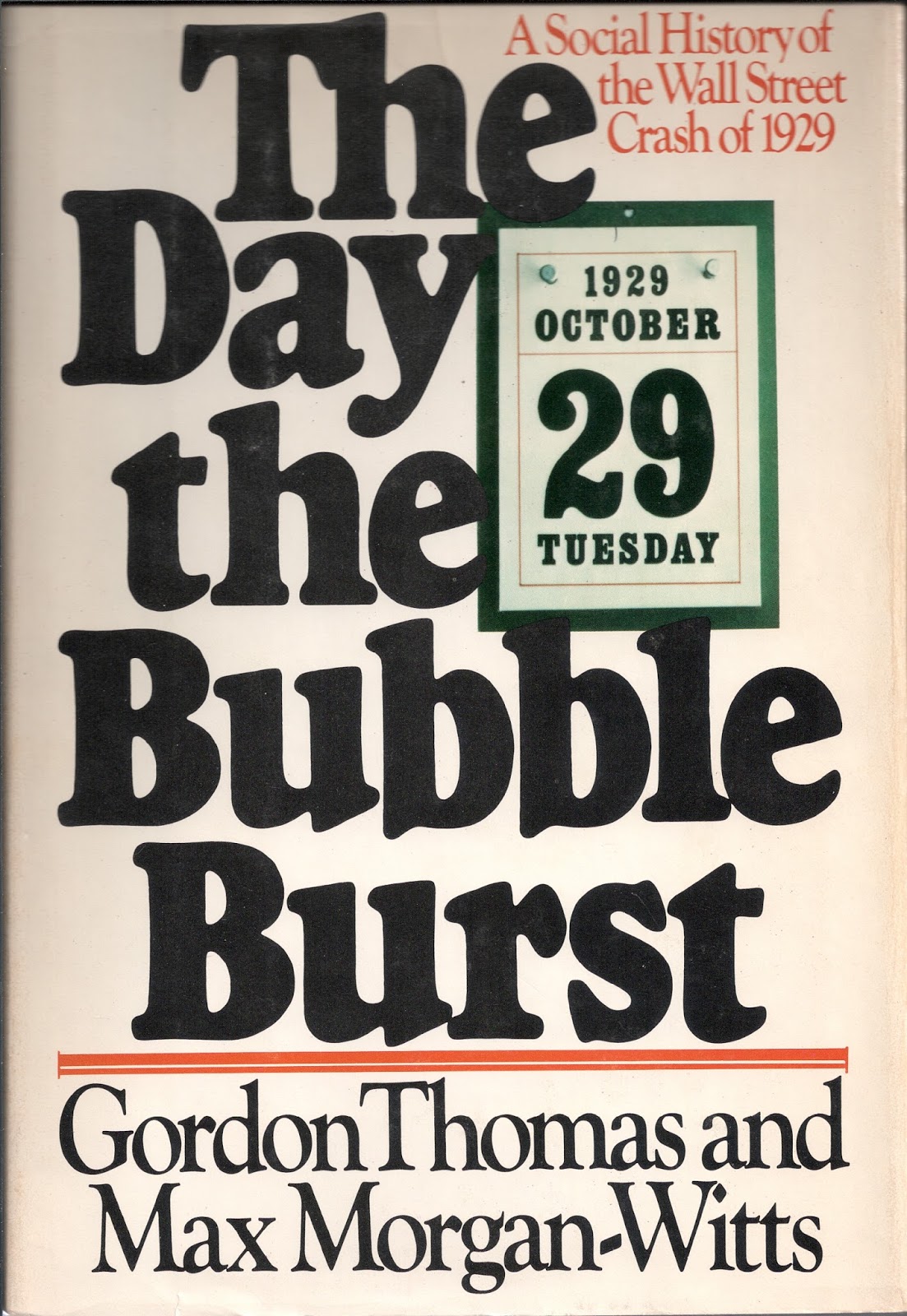
The Day the Bubble Burst - Gordon Thomas and Max Morgan-Witts (Doubleday & Co, 1979)

This is a social history of the Great Crash of 1929.  It weaves together the individual histories of dozens of persons whose lives or fortunes were deeply affected by the Great Bull Market and its subsequent collapse.   [338.54]

Neither of the authors of this book is an economist or a business writer by profession.  The style of the book is quite different from most financial histories in that it spends more of the text on recording the thoughts and feelings of the characters.  In fact, it is more like the style one expects to find in a novel.  The attribution of thoughts or feelings to the main characters would make a reader suspicious of the validity of the accounts except for two things: the book was written forty years ago when many of the principals or their families were still alive and available for interview and the authors cite numerous journals, diaries, and interviews among their sources.

The book covers the last months of the Great Bull Market from New Year's Eve 1928 to October 1929.  It is not restricted to the usual players in the Street, but takes individuals at several levels of society and at venues outside New York.  These individual stories reinforce the narrative by adding a poignancy to human plans overwhelmed by the event.  There are several projects or goals set by the participants for the last week in October that the reader knows will never come to fruition.  The stories include the standard players such as Michael Meehan, the pool operator; Thomas Lamont and George Whitney, partners at Morgan; Richard Whitney, George's brother, embezzling from his customers for one bad investment after another while president of the NYSE; Jesse Livermore,  who often blamed for the Crash because he often sold short; Charles Mitchell, famous for placing bids on behalf of the bankers' group to try to stabilize the market, but who also was selling short the stock of his own bank; and Professor Irving Fisher, the economist whose serious work on the money illusion has been swept aside by his Panglossian pronouncements.  

The authors go further and include other characters to give a broader sense of the easy riches mania that seemed to carry away the country.  There are also Henry Ford, eccentric and living in an America that is fading into the past; Joseph Kennedy, snubbed in his visit to the House of Morgan, but having a better sense of the market than his "betters"; John J. Raskob, focused on his plans to build the Empire State Building; A. P. Giannini, laboring against the fear that his Transamerica Corporation might become a tool for speculators and also seen as an upstart by the J. P. Morgan firm; the "league of gentlemen," fifteen clerks and officers of Union Industrial Bank of Flint, Michigan, each of whom was embezzling from the bank to invest in the stock market; and the Vargo family, immigrants in Flint and bootleggers who trusted their savings to the Union Industrial Bank.

By following each of these stories, the reader is reminded that the Crash did not happen on just one day; the market's collapse took place over several days.  At the end of each of those days, there was a hope that the rally might undo the damage.  The reader will likely feel a pang of sympathy for the characters because we know the end of the story.  That is something too often missing from economic history: the sense that no one at the time knew how the story would end.  We can empathize with their frail hopes.

This book is recommended for a sense of the mania for easy money that swept through society during this period.

Thursday, June 2, 2016

The Big Short: Inside the Doomsday Machine - Michael Lewis (W W Norton, 2010)

An engaging story of the challenges facing a few individuals who bet against common wisdom  to profit on the 2007-8 housing market collapse. [330.973]

One path to good storytelling when dealing with complex issues is to report from the point of view and actions of someone involved in the events.  This doesn't necessarily make the event itself any clearer; instead it trusts that the reader may appreciate the challenges the protagonists face and it conveys a feeling about the events.  This look at the financial implications of the housing market collapse in 2008 attempts to explain events by following three hedge funds and a banker as they try to make sense of what appears to them to be an asset bubble and to find a way to take the opposite side of the trade.  It takes great self-confidence, or foolhardiness, to take a short position when the world is convinced prices can only move upward.

The uninitiated reader is unlikely to come away from this book with a clear understanding of derivatives trading, credit default swaps, or collateralized debt obligations, but this book is not intended as a CFA textbook on derivatives.  In fact, this book should be read alongside Gillian Tett's book Fool's Gold to really understand how such a market developed.  The pair of books gives a richer context to the trading.

Michael Lewis is, nonetheless, a talented writer.  The traders and bankers he describes are complex personalities.  They are not heroic; they see an opportunity to make money and have to develop a way to exploit the situation.  They have to keep their financial backers and investors behind them while the action they propose violates accepted wisdom.  They have to abandon any faith in the leading names in the financial community.  Once events begin to run their way, they have to decide how long to hold the trade before it becomes worthless.  Here is Lewis' talent: giving the reader a sense of the inner workings of these people.

We are still living with the results of the crisis.  It still plays a role in the political campaigns this year because it has affected how we interpret the work of Wall Street, the government, and the markets in a broad sense.  This book is still timely even as it describes events that are a decade ago.

(NB.  The movie of the same name is equally enjoyable and should be watched in conjunction with Margin Call to see both sides of the story, but it has fictionalized some parts of the story and simplified other parts.)

This book is recommended although with the suggestion that the experience improves if one takes time to learn more about the derivatives and the securities discussed.

Thursday, April 28, 2016

Tulipmania - Anne Goldgar (University of Chicago Press, 2008)


A serious review of one of the iconic financial bubbles in European history.  The author suggests that legend has largely shaped our views on its origin, extent, and impact on Dutch society.  [330.949203]

This book re-examines the Tulip bubble of 1636-7.  Its premise is that everything we all have read in Extraordinary Popular Delusions, in Burton Malkiel, and elsewhere is based on flawed documents.  All of these derive from a single 18th century source (or from MacKay who used this same source) that drew its information from 17th century pamphlets.  The pamphlets were written with didactic or moralizing intent rather than as actual history.  They exaggerated the spread of the speculation in society and its economic impacts of the Dutch economy. 

The book asserts that the Tulipmania we all know never really happened.  There was a rise in prices, but the trade was confined to a fairly small community of traders with a high concentration within the Mennonite religious sect.  The records indicate few bankruptcies resulting from the collapse in prices.   The plague in Holland in 1636 led to inherited wealth and a new attitude toward earthly pleasure also encouraged the bubble. 

One interesting financial aspect to the actual trade is that for seven months of the year, the bulbs stay in the ground.  The trade depended heavily on forward markets and prices.  That is why the collapse led to some problems of honor among the merchants - with a forward contract the temptation to renege is high when prices fall.  There is also the problem we saw in the repo fails situation in 2008 when contracts are daisy-chained; one failure to deliver disrupts an entire series of trades. 


The book can be a bit of a long read.  Goldgar, the author, is fairly detailed on the development of tulips as objects of beauty, for the newly prosperous merchant class of Holland in the Golden Age.  She goes then into the society that engaged in the tulip trade and how small this group was and how disputes were settled.  Finally the book begins to address the tulip market.  The main point is that the pamphlets that misled later readers reflected uncertainty about the new social mobility, the rise of new classes and the impact on traditional notions such as value and honor made all the more severe by the stress of dishonored contracts. 


In the end, however, such revisionist history is satisfying.  The book's subtitle "Money, Honor, and Knowledge in the Dutch Golden Age" explains the breadth of the argument.  It makes more sense of what is usually cited as simply the madness of crowds.

This book is recommended and highly recommended for readers with an interest in art history and Dutch culture.

Thursday, April 21, 2016

And the Money Kept Rolling In (and Out) - Paul Blustein (PublicAffairs, 2005)

A history of the collapse of the Argentinian economy during its currency crisis of 2001.  The question is how could a country that seemed to live by the Washington consensus and was the darling of investment banks suddenly fall so far and so fast?   [330.98207]

Over the course of ten years, Argentina went from being the darling among emerging markets to a shattered economy.  The author suggests that much of the damage may have been self-inflicted, but that it was greatly helped along this path by policy decisions and interference by the IMF, the US Treasury, and the financial markets and banks.  These policies helped keep Argentina on an unsustainable path for too long before switching to a wrenchingly painful policy about face.

Argentina came out of the ruinous inflation of the late-1980s by adopting a rigid convertibility scheme of 1 U.S. dollar per 1 Argentine peso and committing to maintain that convertibility.  (In some ways, this action might be likened to going on a gold standard.)  The selection of the dollar for convertibility was odd because there was little tie between the two economies; that would mean that Argentina had fewer means of acquiring dollars as foreign reserves.  In the early 1990s, the economy took off with 10% annual growth and low inflation.  It cannot be said, however, that these were the necessary result of convertibility.  Worse, Argentina did little to change its fiscal policies; it ran deficits of significant size.  Because it was issuing so much debt, its weight in international indices for investment grew (a perverse aspect of indices such as EMBI) and that attracted foreign funds, sometimes justified on the grounds that the very marketability of so much debt was itself a sign of economic strength.

The crises of the mid-90s, in Mexico, Thailand, South Korea, and, worst of all, Russia, shook financial markets.  At this point, the IMF began to prepare for the end of peso convertibility, but Argentina would not budge.  The denouement comes to IMF loans trying to save the situation, the U.S. Treasury changing course to a tougher position, the flight of foreign capital, the uneven adoption of austerity that only slowed economic growth so as to make Argentina's debt burden more unsustainable, and the sudden withdrawal of IMF support.  The financial system collapsed as convertibility was only then ended. 

In sum, unwise policies were held onto for too long.  The global financial forces were too accommodating of the situation and abetted the maintenance of policies such as convertibility and fiscal looseness for longer than was wise.  When the international accommodation ceased, it came at the worst time and too swiftly.  The result was the sufferings of millions.

This book is recommended for its readability and the relevance to other bubbles.


Thursday, April 7, 2016

A Short History of Financial Euphoria - John Kenneth Galbraith (Penguin Books, 1994)

A look at three hundred and fifty years of speculative bubbles and the common characteristics of the major events.  The same dynamic, the same belief in something new appears in surprisingly short cycles.  "The world of finance hails the invention of the wheel over and over again, often in a slightly more unstable version."  [332.645]

This very slim volume (113 pages) is written with Galbraith's wit and sharp insight.  During speculative periods one may note the belief that either some new asset has arisen which can be expected to rise in price for an extended time or that others may be fooled, but it will be possible for the shrewd individual to know when to get off the ride, and that doubters are to be condemned.  Common to the rise of bubbles are the shortness of financial memory (previous episodes are forgotten) and the specious association of money with financial genius.  Unfortunately, the financial innovation that arises is usually some variation on leverage which works wonderfully in rising markets and extracts a terrible price in falling ones.  Those enjoying the benefits of leverage are hailed as financial geniuses.  When the crash comes, something other than greed or stupidity is blamed.  In the past, crashes have been blamed on program trading systems, or government reports, or small changes in GDP.  Certainly, the market cannot be at fault because that would violate the central tenet of the faith in the perfect market.  The last crisis covered is the 1987 savings and loan fiasco and the market collapse.  What gives credit to Galbraith's analysis of the common factors in crashes is that the reader can see the same factors and reactions in the dot com bust and in the great collapse of 2008.   

The author then follows major speculative bubbles from the Tulip mania (a review of another, better work on this will appear here eventually) and the South Sea Bubble through the 1929 crash and the 1987 Meltdown.  Because he is trying to cover 350 years in so few pages, the descriptions are useful only as a reminder of other works one might read of these events.  That becomes the weakest part of the book.  The book's real value lies in the common threads it finds.

This book is recommended with the caution noted above.


Tuesday, March 15, 2016

The (mis) Behavior of Markets - Benoit Mandelbrot (Basic Books, 2004)

One of the pioneers of fractal analysis reviews the role of randomness and turbulence in nature with particular emphasis on financial markets.  [332.01]

This is an important and useful text.  Too often, analysts have swept everything under the rug of the Gaussian (i.e., Normal) distribution.  It represents the victory of ease over analysis.  Assuming the Normal distribution puts tables and easy computations of probability at hand.  Mandelbrot presents evidence that taking the Normal curve as given in many cases when distributions have tails that follow power laws is to err seriously.  In this regard, he presents a critique of much of modern finance that hinges on the Gaussian distribution.      

In fact, one might argue that the real nature of the Black Swan problem is one of misspecification of the underlying probability distribution.  If one reasonably assumes that one probability distribution holds, then an error in selection of that distribution can have significant consequences, especially at the extremes of the distribution.  The Normal distribution, in particular, has quite thin tails: the probability of an event six standard deviations from the mean (the 6 sigma criterion) at 3 per million events is small beyond any plausibility.  All that is guaranteed under Chebyshev's rule, however,  is that the probability of an occurrence at that extreme in no more likely than about 3%.  The difference represents an increase by 10,000 times in probability.  What is assumed rare might, indeed, be disastrously common.    

Unfortunately for this book, its author's personal problems  and history detract from the text.  He insists on reminding the reader that he was a pioneer in the field of fractal analysis.  He revisits previous positions where he was denied tenure or a chair or recognition for his achievement.  Dr. Mandelbrot's reputation is secure; he is not alone in having some of his best work overlooked.  The repetition of these old hurts adds nothing to the text.

This book is recommended with some reservations.

Friday, March 11, 2016

The Great Bull Market - Robert Sobel (W W Norton & Co., 1968)

A history of the economic and financial conditions that drove the bull market of the 1920s.  [332.642097471]

Most histories of the 1920s stock market (and there are some excellent ones) focus on the Crash as the central theme of the book.  This book is refreshing in that it treats the collapse as significant, but not the whole story.

Sobel begins with a description of the immature financial markets of the end of WWI.  Wall Street was not yet a major topic of daily discussion in America.  New York had not yet eclipsed London as the world's financial capital. 

The author looks at a number of individual events that would contribute to the economic growth of the 1920s that fed a real growth in equities and those which added to the speculative frenzy that gave the market its froth.  There were new technologies that were spurred by a new approach to consumer credit that generated, through a macroeconomic multiplier effect, more disposable income in society.  The Washington Naval Conference of 1922 led to some disarmament and a relaxing of tensions following the First World War to further spur consumer confidence.  There was also Winston Churchill's foolish decision to return the United Kingdom to the gold standard at the pre-1914 level.  To help the British prop up the pound, the New York Federal Reserve lowered money market rates that fueled the call money market and buying stocks on margin.  Finally, there was the growth of trusts and informal collusion among major firms, such as steel companies, that increased profits that justified higher stock prices.

What Sobel has done is to re-examine the economic conditions of the 1920s.  He investigates how changes in American society contributed to the forces that created the great bull market.  Although we have a tendency to see the Crash of 1929, in retrospect, as the inevitable result of those forces, Sobel argues hard against that viewpoint.  The reader will find himself reviewing tables of stock prices and other data rather than hearing the famous old stories.  The new insights are worth having.

This book is recommended.

Thursday, March 10, 2016

When Genius Failed - Roger Lowenstein (Random House, 2000)

The story of the rise and painful fall of Long-Term Capital Management.  The hedge fund boasted of its ties to Nobel prize-winning economists as a new approach to efficient markets.  The denouement almost brought down several major Wall Street houses.  [332.6]

It is very human to enjoy a tale of hubris and arrogant certainty when the end of the story comes to ruin; such stories have entertained us since the Greeks gave a word for it 2,500 years ago.  The collapse of the Long-Term Capital Management hedge fund fills that same role.   

Because it is a drama of pride and its hazards, the narrative must invest a large share of its print on the individuals involved and their personalities: the traders, the academics, and the bankers.  In this regard, it is much like the work of writers such as Michael Lewis.  The risk in such writing is that the author will become so focused on the personalities that the book flirts with biography rather than with documenting for understanding the events themselves.  It is assumed that the reader will understand the nature of the trades being undertaken, although a brief explanation is given in many cases. 

In the case of LTCM, however, the basic trade was quite simple.  It was a true hedge fund when its trades involved taking two positions on one security to exploit small differences in actual price from theoretical prices.  An example might be selling the instrument short while buying the future of the same instrument when there is a difference that allows arbitrage of these two.  The key problem was that the differences could be so small that the only way to make money on the trades was through massive leverage.  Money would eventually be borrowed from several large banks and those loans would become the problem for the financial markets.  (I find it ironic that economists of the stature of Merton or Scholes could argue for the efficiency of the market - and that same efficiency would force prices to converge eventually - while not recognizing that the momentary inefficiencies might argue  that the entire theory may be imperfect.)  That became the problem.  After the collapse of the Russian ruble in 1997, prices were not converging fast enough.  Every bank which had lent LTCM money was in danger of taking large losses that could destabilize the system.  Wall Street had to find a way out, but it was a close call.

This book is highly recommended.

Wednesday, March 9, 2016

Devil Take the Hindmost: a history of financial speculation - Edward Chancellor (Penguin Putnam, 2000)

As long as markets have been part of Western society, there have been periods of frantic speculation - of bubbles - that have destroyed some of their participants when the world suddenly changed.  This is a history of some of these events.  [332.645]

A colleague who worked as a financial advisor once told me that he gave a copy of this book to every new client.  In looking over this book again, I must admit that he was acting in his clients' interest if his intention was to warn them about the likely tears that would follow any enthusiasm for the next sure thing. 

The text covers the major speculative frenzies from the South Sea Bubble to the Asian crisis of 1997.  In each, one meets knaves and swindlers and deluded crowds who are driven to get rich easily with their, usually, small capital.  The story always ends up the same, but often in new ways each time.  The catalogue of disasters is long; it includes the South Sea Bubble, the railway mania of the 1840s, the market manipulation of the Gilded Age, the Crash of 1929, the shady trading of the 1980s, and the Japanese collapse of the 1990s.

The author does more than recite the sequence of events.  He adds a commentary that brings many of these stories to bear on current attitudes.  For example, Chancellor draws a set of parallels between the attitudes and approach of the investor in the 1920s bull market and those of the investor of the 1990s.  Such texts remind us of why history is so important.

This book is highly recommended.