Showing posts with label stock market. Show all posts

Saturday, September 29, 2018

The Go-Go Years - John Brooks (Weybright & Talley, 1973)

An episodic history of the equities markets during the decade of the 1960s to show how the market transformed from a gentleman's club to a national market.  [332.64273]  

The decade of the 1960s on Wall Street is likely remembered as a period characterized by a steadily rising stock market.  Fifty years on, not much else may survive in the details, but it might be thought of as a bland and safe age compared to the crashes of 1929, 1987, the dot-com era, or 2008.  This stands in sharp contrast to the sense of social upheaval in the United States during the same decade.  This book offers evidence that the 60s were certainly not bland nor was the market on a steady upward path throughout the period.

Brooks' central theme is that the decade saw the final transition of Wall Street from a private gentleman's club to a national financial market.  The story is told through a series of individual biographies of characters who stood for their brief moment on the financial stage with the collection bracketed by the record one-day loss of H Ross Perot in his losses from a sharp drop in EDS.

Here are the stories of the American Stock Exchange trying to right itself and avoid the scandal of corruption among its leaders, of Eddie Gilbert gambling desperately to finance continuing acquisitions of competitive flooring firms, and of a somnolent SEC and a major insider trading scandal among the directors of Texas Gulf Sulfur.  As these events are sweeping out the old, slow ways of the Street, a new generation of fund managers is coming to the fore.  These are the Gunslingers: mutual fund managers who took heavily concentrated positions and moved in and out of investments rapidly to show "performance."  There were also the new conglomerates.  These were collections of companies created by mergers and acquisitions across multiple industries.  It was argued that there was some mystic synergy that made sports equipment, tractors, and dish soap manufacturers better if they were all part of one larger corporation.  Finally, there were the hyper-growth, new technology firms that attracted investors whose money could be used for more ambitious growth.  One might see, for example, a computer leasing firm making a bid to take over a major money center bank.

The market itself was beginning to attract the interest of many new, small investors as Wall Street became more of a national institution.  It wasn't prepared for this new role.  Clearing paper share certificates became a backroom nightmare.  Customers accounts were in disarray and the problem was growing.  In an attempt to stem the problem, brokerages were to close one day a week and not solicit new business.  In a story familiar to anyone acquainted with the growth of synthetic MBS until 2008, the firms could not resist the additional profit in new accounts - and churning those accounts - in an era of fixed, high commissions.

As the economy began to slow in 1969, the brokerages took in less income.  Many had lived with almost fictional capital assets and failures in several brokerages, including some of the largest houses, began to stress the NYSE.  (There was, as yet, no Security Investors Protection Corporation - SIPC -  to insure investors' accounts.)  As share prices sagged, the performance of the hot-handed gunslingers seem to cool.  This bears out John Kenneth Galbraith's aphorism that "genius is a rising market."   It could be seen that by the end of 1970, actual performance over the decade for many hot hands had been nil.  The synergy of the conglomerates and their stock prices evaporated.  That synergy proved to be only the result of accounting manipulation made possible by acquiring firms with lower price to earnings multiples.  The Dow Jones index which had touched 1,000 in 1966 wouldn't return to that value until nearly the end of 1972.

By the end of the decade, despite all the pain of growth and transition, Wall Street was something new.  It had become integral to American life in a way it hadn't been before.  Where it was once a spectator sport, it now held pensions and individual savings that would make it critical to more households.  To be more a part of the life of many Americans, however, would mean that the slumps and bubbles that seem an inevitable part of markets would have more that an academic impact for the average citizen than in times past.  This may be the reason, more than simply because they are in recent memory, why the crashes of 1970, 1987, 2000, and 2008 had such an impact in ways that the 1954 or 1962 slides did not.      

This book has been re-issued in the Wiley Investment Classics series and it very much deserves to be.  It is strongly recommended because it covers a market era that is usually overlooked. 

Tuesday, April 25, 2017

Once in Golconda: a true drama of Wall Street 1920-1938 - John Brooks (W W Norton & Co, 1969)


A very talented writer describes the mood and the events of the 1920s boom, the crash, and the aftermath.  Brooks wrote with great clarity.  Each of his business history books deserves a look.  [332.64273]

The Wall Street crash of October 1929 stands as a milestone in American financial history that surpasses all others.  The panics and crashes that preceded it are lost in popular history; those that have followed it are constantly compared against it the way geologic events are compared with the August 1883 Krakatoa eruption or the April 1906 San Francisco earthquake.

In a similar manner, the books written about the 1929 Crash all spend some time examining the popular culture of the age.  The sense of easy money is a frequent topic; what review of the age doesn't mention John J. Raskob's "Everybody Ought to be Rich" magazine article?  The day-by-day events of that October are also popular material for these histories.   These are offered as a means of contrast with our own less frenzied or more sophisticated age.  When the 'twenties are contrasted too strongly with the present, it can lure us into a complacency; we can see how the sins of the past led to the downfall, but, as we are not guilty of such greed and passion, no such calamity awaits us.  History has proved this wrong many times.

John Brooks, however, has a more subtle eye.  His narrative does not stress the extraordinary nature of that age, although he discusses some of the major figures of the era.  His narrative encompasses the economic forces that imposed changes on the nation and the social changes that marked a permanent turning in the society's mores and viewpoint.  Further, Brooks covers the period more fully: from the 1920 bomb that exploded at lunchtime on Wall Street to the Pecora hearings and Richard Whitney entering Sing Sing in 1938.  In fact, Whitney becomes the central character in the history and his personal fall chronicles the falling away of the old elite and its replacement by a new generation.  When seen from this view, the 1920s are not extraordinary or distinct from later years, they are the time when the attitudes of our era first emerged. 

This book is very highly recommended.


Friday, October 28, 2016

The Money Game - 'Adam Smith' (Random House, 1967)

A witty exploration of the psychology of Wall Street - why people play the game and how they do it.  This is not another investment guide; it is brilliant sociology.  [332.678]

How is the investment world of 50 years ago different from today?  Maybe there are fewer brokers that the client calls to see how the market is doing.  There are fewer old-line investment houses functioning as banks for wealthy clients.  Along with that, the old fixed commission system is gone that supported so many of those old houses.  There are more investment products available, even as some industries (e.g., aluminum) offer fewer companies to choose among.  Certainly, there is more information about prices and markets within easy reach.  The author would argue, however, that one thing has not changed: the underlying motivation for many participants in the market.  Taking a comment from Lord Keynes, the author argues that it is the game aspect itself of speculative investment that draws many players.  Yes, money is useful for keeping score, but it may not be the end in itself that is being pursued.   

George J. W. Goodman, writing under the pseudonym Adam Smith, draws a series of portraits of the players and in sketching them highlights their inner workings.  The cast includes Odd-Lot Robert who is the small investor who always thinks the "Big Boys" are planning something; Charley and Poor Grenville, and the Kids, all fund managers; the professional gang hanging around Oscar's who could have walked off the set for Mad Men; several investors who are patients of Harold the Psychiatrist who reveal all the ways in which money and the market fit into their lives and it usually isn't in the ways economists assume money fits into a rational individual.  They are Chartists, analysts, small investors (in odd lots), irredeemable speculators, and guys who just like to trade information.   One key that the author finds is how many players just want to be in on the game; they want to be where there is action.

For a light diversion, there is a chapter on The Cocoa Game to warn against the very different world of commodity trading.  For a darker chapter, the Gnome of Zurich appears to present speculations about the dollar and trade and gold that a dozen years later would all prove true. 

The writing is bright and clever.  The humor is subtle yet rich like the clubs that Goodman describes.  This is a book to read when one wants to be reminded that the world continues in a great cycle of rising markets, hot prospects, disillusionment, and gloom...and that it always has been that way.

This book is highly recommended.   

Wednesday, August 31, 2016

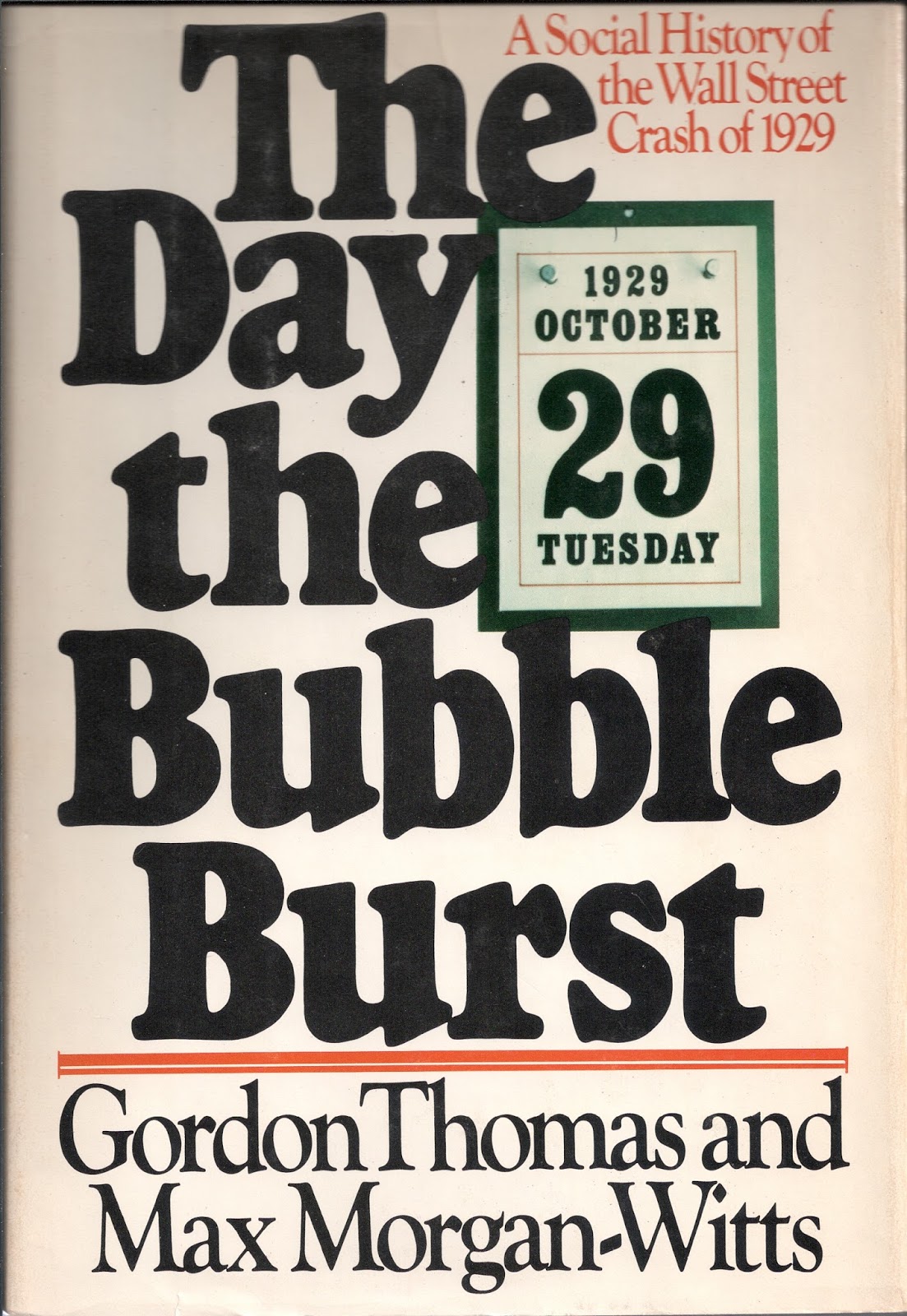
The Day the Bubble Burst - Gordon Thomas and Max Morgan-Witts (Doubleday & Co, 1979)

This is a social history of the Great Crash of 1929.  It weaves together the individual histories of dozens of persons whose lives or fortunes were deeply affected by the Great Bull Market and its subsequent collapse.   [338.54]

Neither of the authors of this book is an economist or a business writer by profession.  The style of the book is quite different from most financial histories in that it spends more of the text on recording the thoughts and feelings of the characters.  In fact, it is more like the style one expects to find in a novel.  The attribution of thoughts or feelings to the main characters would make a reader suspicious of the validity of the accounts except for two things: the book was written forty years ago when many of the principals or their families were still alive and available for interview and the authors cite numerous journals, diaries, and interviews among their sources.

The book covers the last months of the Great Bull Market from New Year's Eve 1928 to October 1929.  It is not restricted to the usual players in the Street, but takes individuals at several levels of society and at venues outside New York.  These individual stories reinforce the narrative by adding a poignancy to human plans overwhelmed by the event.  There are several projects or goals set by the participants for the last week in October that the reader knows will never come to fruition.  The stories include the standard players such as Michael Meehan, the pool operator; Thomas Lamont and George Whitney, partners at Morgan; Richard Whitney, George's brother, embezzling from his customers for one bad investment after another while president of the NYSE; Jesse Livermore,  who often blamed for the Crash because he often sold short; Charles Mitchell, famous for placing bids on behalf of the bankers' group to try to stabilize the market, but who also was selling short the stock of his own bank; and Professor Irving Fisher, the economist whose serious work on the money illusion has been swept aside by his Panglossian pronouncements.  

The authors go further and include other characters to give a broader sense of the easy riches mania that seemed to carry away the country.  There are also Henry Ford, eccentric and living in an America that is fading into the past; Joseph Kennedy, snubbed in his visit to the House of Morgan, but having a better sense of the market than his "betters"; John J. Raskob, focused on his plans to build the Empire State Building; A. P. Giannini, laboring against the fear that his Transamerica Corporation might become a tool for speculators and also seen as an upstart by the J. P. Morgan firm; the "league of gentlemen," fifteen clerks and officers of Union Industrial Bank of Flint, Michigan, each of whom was embezzling from the bank to invest in the stock market; and the Vargo family, immigrants in Flint and bootleggers who trusted their savings to the Union Industrial Bank.

By following each of these stories, the reader is reminded that the Crash did not happen on just one day; the market's collapse took place over several days.  At the end of each of those days, there was a hope that the rally might undo the damage.  The reader will likely feel a pang of sympathy for the characters because we know the end of the story.  That is something too often missing from economic history: the sense that no one at the time knew how the story would end.  We can empathize with their frail hopes.

This book is recommended for a sense of the mania for easy money that swept through society during this period.

Monday, August 15, 2016

The Match King - Frank Portnoy (Profile Books Ltd, 2009)


In a time of economic exuberance, even sophisticated investors, bankers, and brokerages were not too interested in where the dividends came from.  This is the story in detail of one of the greatest collapses - or was it fraud - of the 20th century.  [364.1680924]

It would seem that every book about the 1929 Wall Street crash makes passing reference to Ivar Kreuger and the collapse of his "Match Empire."  Although, his name is often teamed in such histories with those of Samuel Insull and Charles Ponzi, there is a critical difference.  Ponzi's scheme was limited and had no hope of being a legitimate investment; Insull's network of utilities and holding companies was merely regional; Kreuger built an international enterprise that was capable of lending funds to sovereign governments, that developed new financial tools (such as nonvoting Class B shares and convertible debentures), and that could rival the House of Morgan.  Ivar Kreuger and his match monopolies were in a different league - almost appropriately the same league as the South Sea Bubble.

This book is more than a recounting of some facts; it is the biography of an enigma.  How much about Kreuger's life or business dealings was real?  how much was sleight of hand?  Further, why would a old banking house like Lee Higginson participate so willingly in raising funds for International Match or the firm of Kreuger and Toll when they really knew so little about the business?  How could the most cursory of financial data be trusted as a guide to understanding a complex firm?  Here is a look at how financial markets operated before requirements for audited financial statements or registration of securities became standard.  In good times, as many subsequent market booms have shown, investors do not really want to look too carefully under the hood of the engine that is generating profits.  It did not seem to trouble investors that their investments paid a 25% dividend on money lent to Germany for 6%.  In  the absence of solid accounting data, funds could be raised and shifted among a number of off-balance sheet vehicles and firms without the knowledge of investors or the firms' bankers.  Today, an investor will study the 10-Ks and 10-Qs of prospective investments.  These tools only came into being after, and partly because of, the collapse in 1932 of Kreuger's empire once the search for remedies for the losses that all came with the end of the 1920s bull market began. 

After every collapse, there is a desperate search for a single, simple cause or villain to blame and widespread human greed or blindness is never really an acceptable explanation because it spreads guilt too broadly - it might include ourselves.  Although the International Match shares held their value for almost two years after the crash of most other share prices, when they fell, they became the focus of blame.  Suddenly, the now-dead Kreuger could not defend himself against harsh, self-interested accusations.  Some of these charges are believable.  (The forged Italian treasury bills that Kreuger had used argue that.)  Time, however, would reveal that many of the assets of International Match and its associated companies were genuine.  The author leaves his conclusions mixed: part blameworthy, part exculpatory for Ivar Kreuger.  That is, perhaps, the most satisfactory approach.

This book is recommended with the note that some readers may wish to reconstruct some basic accounting statements to better understand the whole.

  . 


Friday, March 11, 2016

The Great Bull Market - Robert Sobel (W W Norton & Co., 1968)

A history of the economic and financial conditions that drove the bull market of the 1920s.  [332.642097471]

Most histories of the 1920s stock market (and there are some excellent ones) focus on the Crash as the central theme of the book.  This book is refreshing in that it treats the collapse as significant, but not the whole story.

Sobel begins with a description of the immature financial markets of the end of WWI.  Wall Street was not yet a major topic of daily discussion in America.  New York had not yet eclipsed London as the world's financial capital. 

The author looks at a number of individual events that would contribute to the economic growth of the 1920s that fed a real growth in equities and those which added to the speculative frenzy that gave the market its froth.  There were new technologies that were spurred by a new approach to consumer credit that generated, through a macroeconomic multiplier effect, more disposable income in society.  The Washington Naval Conference of 1922 led to some disarmament and a relaxing of tensions following the First World War to further spur consumer confidence.  There was also Winston Churchill's foolish decision to return the United Kingdom to the gold standard at the pre-1914 level.  To help the British prop up the pound, the New York Federal Reserve lowered money market rates that fueled the call money market and buying stocks on margin.  Finally, there was the growth of trusts and informal collusion among major firms, such as steel companies, that increased profits that justified higher stock prices.

What Sobel has done is to re-examine the economic conditions of the 1920s.  He investigates how changes in American society contributed to the forces that created the great bull market.  Although we have a tendency to see the Crash of 1929, in retrospect, as the inevitable result of those forces, Sobel argues hard against that viewpoint.  The reader will find himself reviewing tables of stock prices and other data rather than hearing the famous old stories.  The new insights are worth having.

This book is recommended.

Tuesday, March 1, 2016

Business Adventures - John Brooks (Weybright and Talley, 1969)

A collection of Brooks' articles published between 1959 and 1969 covering stockholders' meetings, stock market fluctuations, insider trading, non-compete contracts, and a marketing fiasco. [650.0973]

Can there be a better business writer than John Brooks?  The clarity and verve of his articles, many from The New Yorker, convey a sense of a world that now seems long gone: the corporate world of the late 1950s and the 1960s.  This is the age before hedge funds and lords of finance; it is the dying end of the era of white shoes, good clubs, and good schools. 

Among the choices are "One Free Bite" about an engineer being recruited by a competitor and the effort his current employer invested in keeping him from accepting new employment while also reminding him that his career with the current firm was now destroyed.  The article looks at the legal basis of noncompetitive clauses in employment contracts.

Another fine piece is "A Reasonable Amount of Time" which looks at the SEC's difficulties in proving insider trading in a case at Texas Gulf Sulphur.

"Stockholder Season" looks at the culture of the shareholders' meeting and how corporate boards use them to maintain the status quo.

Perhaps the prize of the collection is "The Fate of the Edsel."  The piece asks how one of the world's largest manufacturers with decades of experience in marketing consumer goods could fail so miserably in introducing a new product within their own markets.   Brooks takes the reader through the entire development process from identifying a need, creating a design, setting up a distribution network, and planning a marketing campaign.  The entire project failed miserably within three years of product launch.  Brooks' insights into why are the most surprising.

John Brooks (1920 - 1993) was a writer and longtime contributor to The New Yorker magazine, where he worked for many years as a staff writer, specializing in financial topics.

This book, like so many of his works, is recommended for any reader interested in business and its impact on American life.